


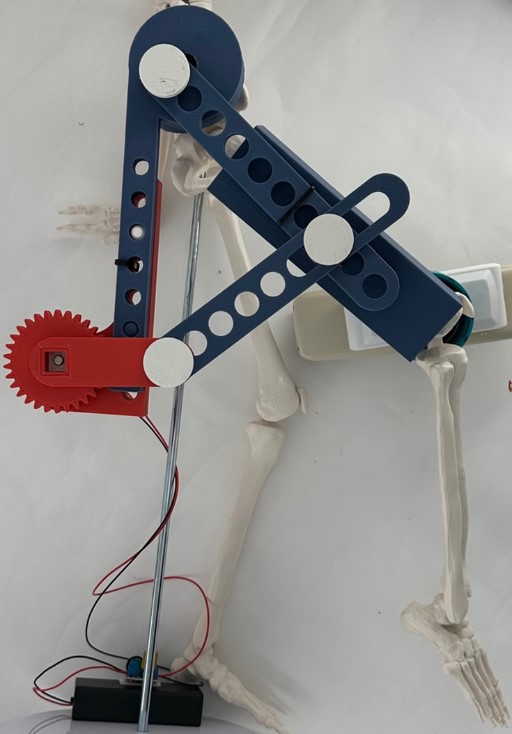
Auxiliary stair climbing device
Authors: KUO TSU-HSIANG; HSU, SHUO-WEN; ZHENG, JIA-CHENG; CHAN, CHVN-BAU; SHI, JUN-EN
Company/Institution: Jen-Teh Junior College of Medicine, Nursing and Management,Rehabilitation of science
Country: TAIWAN
e-mail: eddie@wiipa.org.tw
web: https://www.tippa.org.tw/
For home caregivers assisting cases with lower limb muscle weakness, the proportion of Taiwan’s population over the age of 65 has been increasing annually. With population aging, sarcopenia syndrome is gradually gaining attention. Although the mechanisms of sarcopenia and aging are still under research and investigation, it is currently understood that the core concept of sarcopenia involves a decline in muscle strength, mass, or physiological performance beyond the level expected for the individual’s age. This decline manifests as weight loss, decreased muscle strength, and reduced mobility.
This new assistive device is designed to aid individuals with lower limb muscle weakness or those experiencing mobility difficulties in the lower limbs due to illness or injury when climbing stairs. The device is worn and fixed to the user’s waist and above the knee joint. Through the rotation of a motor-driven linkage, it assists the user by facilitating quadriceps contractions during stair climbing, thereby reducing the physical burden of climbing.
Users can also utilize this stair-climbing assistive device for lower limb rehabilitation and muscle training, effectively reducing the risk of sarcopenia among the elderly and enhancing their quality of life. The device aims to help individuals with lower limb disabilities achieve an active and fulfilling life.

