


Topical Multiparticulate Delivery Systems Based On Biopolymers With Controlledrelease Of An Anti-Inflammatorydrug And Process For Their Preparation
Author: Mihaela Violeta GHICA, Mădălina Georgiana ALBU KAYA,Denisa Ioana UDEANU, Minodora Maria MARIN,Ștefania MARIN, Durmuș Alpaslan KAYA,Cristina Elena DINU-PÎRVU, Lăcrămioara POPA, Elena DĂNILĂ
Company/Institution: Carol Davila University of Medicine and Pharmacy, Bucharest, Romania
Country: Romania
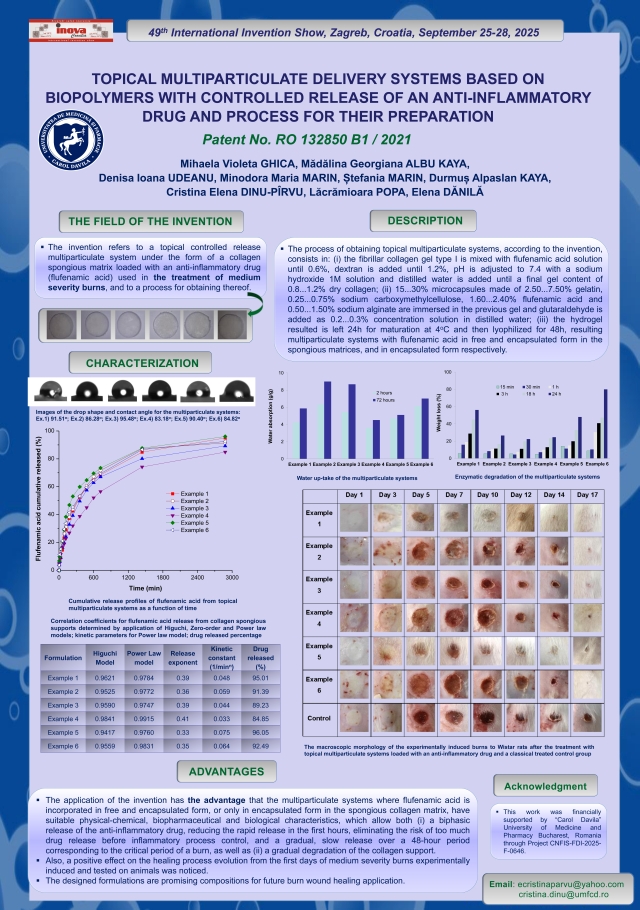
The invention refers to a topical controlled-release multiparticulate system in the form of a collagen spongious matrix loaded with an anti-inflammatory drug (flufenamic acid), used in the treatment of medium-severity burns, and to a process for obtaining it.
▪ The process of obtaining the topical multiparticulate systems, according to the invention, consists of:
(i) Fibrillar collagen gel type I is mixed with a flufenamic acid solution up to 0.6%; dextran is added up to 1.2%; pH is adjusted to 7.4 with a 1M sodium hydroxide solution; and distilled water is added to reach a final gel content of 0.8–1.2% dry collagen.
(ii) 15–30% microcapsules composed of 2.50–7.50% gelatin, 0.25–0.75% sodium carboxymethylcellulose, 1.60–2.40% flufenamic acid, and 0.50–1.50% sodium alginate are immersed in the previously prepared gel, and glutaraldehyde is added as a 0.2–0.3% concentrated solution in distilled water.
(iii) The resulting hydrogel is left to mature for 24 hours at 4°C, and then lyophilized for 48 hours, resulting in multiparticulate systems containing flufenamic acid in both free and encapsulated forms within the spongious matrices, or in encapsulated form only.
▪ The application of the invention has the advantage that the multiparticulate systems, where flufenamic acid is incorporated in both free and encapsulated forms, or only in encapsulated form within the spongious collagen matrix, have suitable physical–chemical, biopharmaceutical, and biological characteristics. These properties allow:
(i) A biphasic release of the anti-inflammatory drug—reducing rapid release during the first hours and eliminating the risk of excessive drug release before inflammation control, followed by a gradual, sustained release over a 48-hour period corresponding to the critical phase of a burn;
(ii) A gradual degradation of the collagen support.
▪ Additionally, a positive effect on the evolution of the healing process from the first days of experimentally induced medium-severity burns in animal models was observed.
▪ The designed formulations represent promising compositions for future burn wound healing applications.

