


Nanotechnology in Tissue Engineering: Overcoming Traditional Challenges for Tissue Repair and Regeneration
Authors: Arad Jamali, Radin Kouhikamali, Hirad Sayyad, Avesta Hoshdar Ekhlassi, Mohammad Fazeli Mosleh Abadi
Company/Institution: Arad Jamali, Radin Kouhikamali, Hirad Sayyad, Avesta Hoshdar Ekhlassi, Mohammad Fazeli Mosleh Abadi
Country: IRAN
Web: www.irtopinventors.com
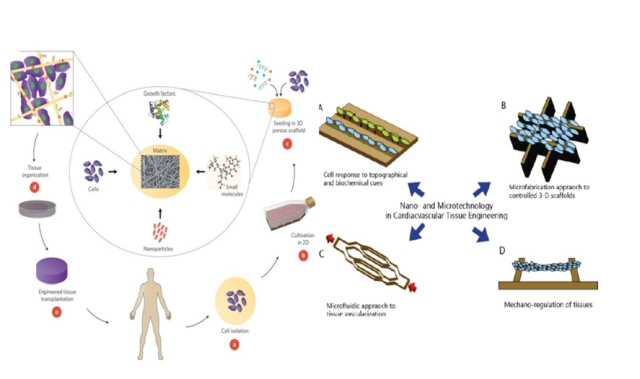
Tissue engineering is an interdisciplinary field combining materials science, biomechanics, cell biology, and medicine to regenerate or repair damaged tissues and organs. It relies on scaffolds, cells, and growth factors, but traditional methods face challenges like weak mechanical strength and poor nutrient transport. Nanotechnology has helped overcome these limitations by enhancing scaffold properties, improving cell interactions, and enabling controlled delivery of biomolecules. Techniques such as electrospinning and soft lithography create biomimetic nanoscale scaffolds for applications in bone, cartilage, nerve, vascular, and liver tissues. Nanomaterials also support targeted drug and growth factor delivery, accelerating tissue regeneration. Pioneering work by Green in the 1970s and later innovations by Vacanti and Langer established the foundations of the field. Today, nanotechnology integration is expanding possibilities in regenerative medicine, offering solutions to organ shortages, personalized therapies, and advanced implants. While scalability and regulatory barriers remain, this convergence is revolutionizing healthcare with patient-specific, next-generation treatments.

